









Part one of a four-part series
Editor’s Note: As the monthly publication serving our historic communities, it is our mission here at Resident News to keep our readership informed of the news of the day and how it impacts our residents and neighborhoods. While much of what we report consists of current events, when a community approaches a milestone anniversary – as San Marco is doing in this, its centennial year – we feel it necessary to take a step back in time and share the larger story of how the community came to be.
As stewards of these community stories, we wish to share this history with our entire readership, on both sides of the river. Please enjoy this first installation of a four-part series about the history of San Marco.
Looking at the bustling, thriving community of San Marco today, it’s hard to believe it all started with Telfair Stockton’s idea to transform a clay pit into a lake. Yet that’s precisely what happened when Stockton filled the clay pit at Gamble and Stockton Brick Company to form Lake Marco, a water feature to complement a new residential development he planned to build on the former site of his brick company.
He would call it San Marco.
“[Telfair] realized he could make a lot more money selling real estate if [the brick plant] was a lake rather than his brick company,” said Jacksonville historian Dr. Wayne Wood. “So he closed the brick company and filled in the lake and made it a water feature. It helped sell the lots of San Marco.”
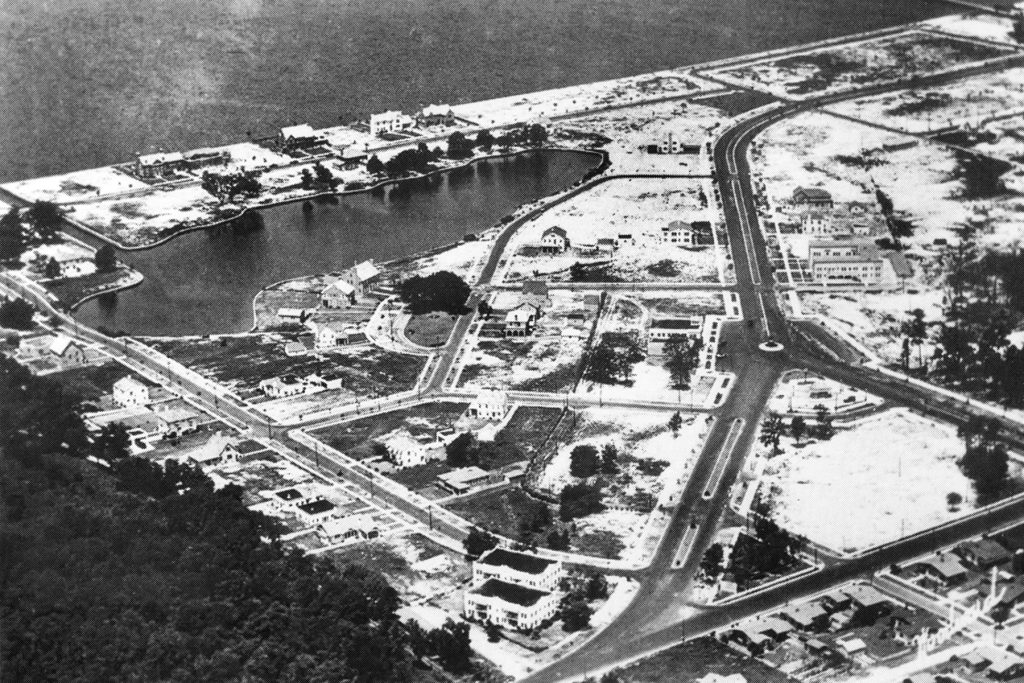
Thanks to a successful marketing campaign promoting the incoming development, Stockton sold all 250 lots the first day sales opened in September 2025.
Those 250 lots of that early San Marco development was a separate entity from what was, at the time South Jacksonville, which occupied the area we know as San Marco today. Stockton’s San Marco was southwest of that area, encompassing just over three square miles and consisting of 80 acres.
“[San Marco] only went to Arbor Lane and it went as far north as Landon,” Wood said. “That was the dividing line with South Jacksonville.
South Jacksonville: Precursor to San Marco
When South Jacksonville was incorporated in 1907, it had 600 residents and stood as a city separate from Jacksonville on the other side of the river. Predating the San Marco development, new infrastructural updates were added to make South Jacksonville more accessible, including the major thoroughfare Atlantic Boulevard and the St. Johns River Bridge – today known as the Acosta Bridge.
Before the bridge was constructed, anyone wishing to travel to South Jacksonville by automobile had to use the ferry to cross the river.
“Within 10 years after it was incorporated, South Jacksonville’s population had increased tenfold and that’s when it was time to open the bridge,” Wood said.
The St. Johns River Bridge was completed in July 1921.
South Jacksonville continued to develop and the same year that Stockton was taking down payments on its new San Marco lots, construction began in South Jacksonville on what would become known as San Marco Square, famously named after Piazza San Marco in Venice, Italy.
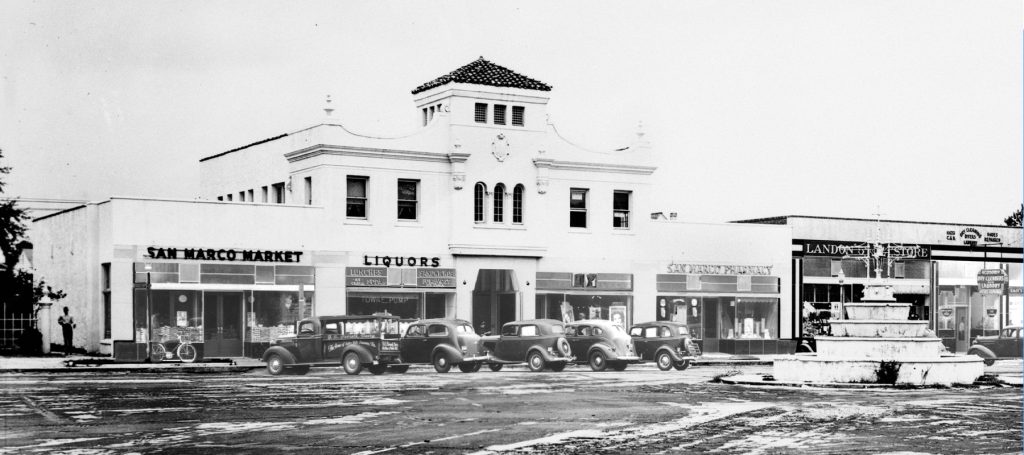
The Square served as the anchor to what would become the commercial area of South Jacksonville and present-day San Marco. The first commercial building to be built in that budding commercial zone still stands today – the San Marco Building, designed by architects Marsh and Saxelby. The Town Pump Tavern is one of its best known tenants, operating out of the building from 1933 to 1983. Today, Starbucks, Beau Outfitters and VooDoo Brewing, Co. occupy the building.
South Jacksonville remained its own city until voters voted in favor of annexation into Jacksonville in 1932, Wood explained. At that point, its population had grown to roughly 5,000.
Just a few years after the annexation, another notable San Marco building was built in the Square: The San Marco Theater opened its doors on June 5, 1938, with a screening of Edward G. Robinson’s “A Slight Case of Murder” for 30 cents a ticket. One of the most elegant vintage theaters in Jacksonville, the Art Deco style structure was designed by architect Roy A. Benjamin. Though the theater closed in January 2023, its iconic marquee remains.
Remnants of South Jacksonville are visible in the architecture of San Marco: The old South Jacksonville city hall building still stands today at 1468 Hendricks Avenue. Today, the building is home to San Marco Preservation Society and Greenscape of Jacksonville. Aardwolf Brewing Company now operates out of what was once the South Jacksonville Utilities building, originally built in 1927, and La Napolera now stands where South Jacksonville Water Works was.
The Stock Market Crash and the San Marco Expansion
Just three months before the stock market crash, Stockton and his associates acquired the land south of the San Marco development, formerly part of Martha Mitchell’s Villa Alexandria, and began selling lots along River Road, marking the start of Stockton’s expansion of San Marco.
It was there that John H. Swisher and Carl S. Swisher built their Mediterranean-Revival style mansions. Up until that point, Wood said, most of the houses in San Marco did not reflect that architectural style, though it was already a popular architectural trend across the state during that time and, in fact, there were already several prominent structures in Jacksonville reflecting those design elements.
“The two Swisher houses were among the biggest houses built in San Marco in that era and they were the first really big ones to evoke that Spanish-Italian architecture,” Wood said.
The stock market crashed in October 1929. While North Florida was not as deeply impacted as South Florida was, Wood explained the “spillover effects” were strong enough to be felt.
“Telfair Stockton was well-financed; he was a genius at marketing and real estate, so his development continued on, although not as robustly as it did in the earlier…days,” Wood said.
Stockton died before he could see his dream of San Marco come to fruition, lots of his San Marco development and its extension continued into the 1930s, Wood said, and possibly into the 1940s as well.
With a clay pit and a vision, Telfair Stockton laid the groundwork for what would become a community that, a century later, continues to thrive and grow.
Read the next installation of this four-part series in the next issue of Resident News.