










Guardians of the Nest
A walk on any of our local beaches along the vast Atlantic Ocean shoreline is awe-inspiring, easily among the most incredible, accessible experiences North Florida offers.
Add the chance to see endangered sea turtles, hatchlings or their nests, and the thrill factor skyrockets.
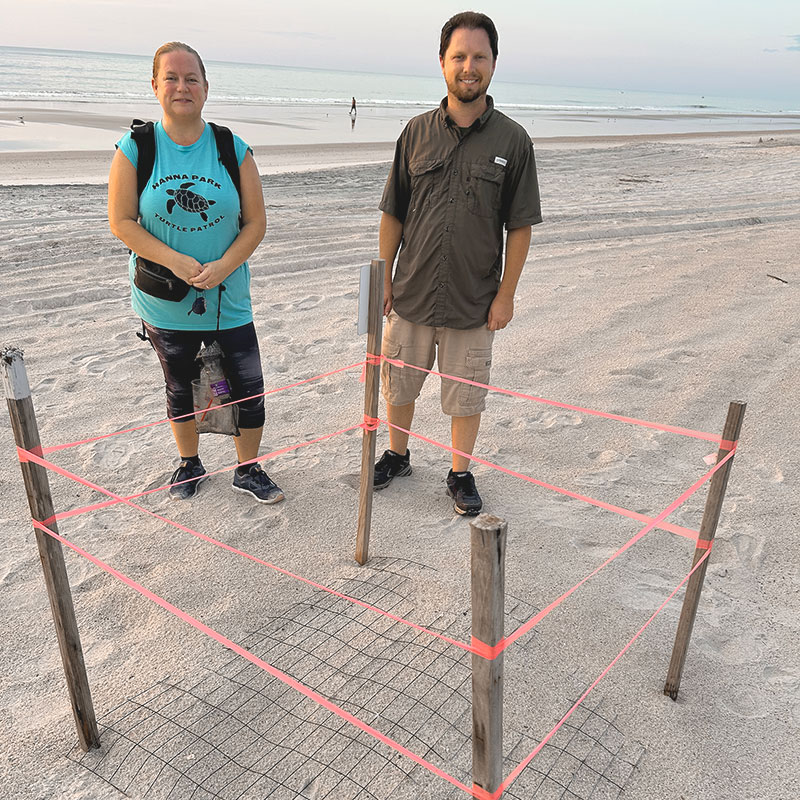
Local sea turtle experts Stephen Klem and Lucas Meer share that exhilaration with beachgoers, especially between May 1 and October 31 – sea turtle nesting season – when they emphasize the need for awareness of and protection for turtles and nests at the beach.
Klem is the sea turtle permit holder/sea turtle patrol and naturalist for Kathryn Abbey Hanna Park. Meer is program director for Jacksonville University’s Sea Turtle Program and sea turtle patrol permit holder at Mickler’s Landing.
Sea turtles are marine reptiles that must surface to breathe, but spend their lives at sea. Only females ever come ashore and then only to nest every two to four years. All species are endangered. Females search for coarse dry sand where they dig deep nests, lay eggs, and completely cover them.
After approximately 60 days, the eggs hatch and turtles weighing one ounce and measuring two to two and a half inches crawl from their nests, usually overnight. The hatchlings instinctively move away from the dark (landside) and toward the moonlight reflected on the ocean’s surface. Once they reach the shore, they launch into the water, frantically swimming to the deep sea.
Hatchlings that emerge at dawn are more vulnerable to predators during daylight. Fire ants, ghost crabs, birds, foxes, raccoons, unleashed pets, and unsupervised children can destroy nests and eggs and even injure or kill sea turtles hatchlings.
Olivia Garmendia Amaral had no idea that her midday beach walk during the Labor Day weekend would turn into a loggerhead hatchling turtle rescue until she saw the half-dollar-sized baby, limp on the dry sand, far from water.
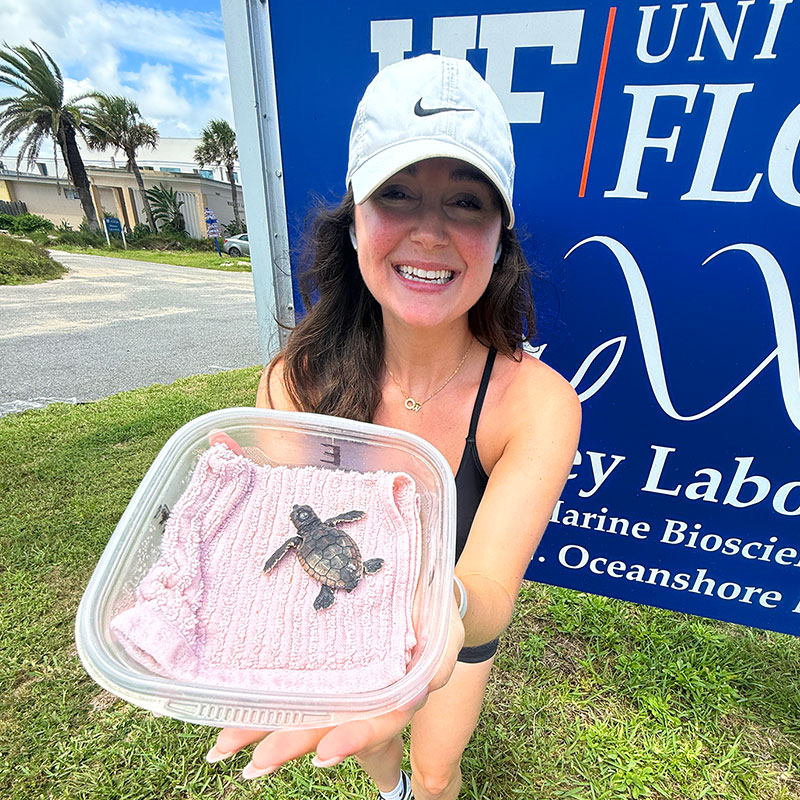
“It was dry, eyes closed… motionless,” she said. “A seagull stood nearby, watching the tiny body. I thought the turtle was dead, but when I picked it up, both eyes opened, and it weakly lifted its head. Once in the ocean, it floated but could not swim as the waves pushed it back onshore.”
That scenario – called washback – is deadly for hatchlings that are driven to find deep water. If strong ocean waves keep washing them back onshore, they become weaker with every attempt until they are stranded out in the sun, helplessly exposed to predators.
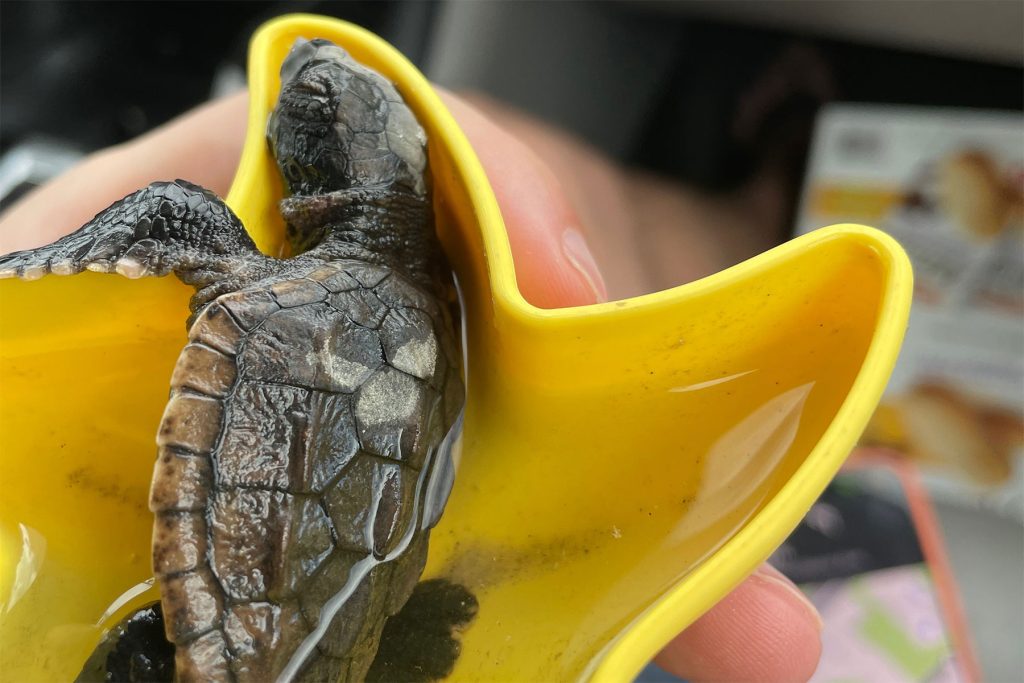
Amaral fortunately found a small, abandoned starfish-shaped beach toy that could hold salt water. She carefully placed the hatchling half into the water while she searched the Internet for sea turtle rescues. The first contact that answered was the Sea Turtle Hospital/UF Whitney Laboratory in St. Augustine.
A kind person told her the baby had hatched the night before or that morning but was an exhausted victim of backwashing. She invited Amaral to bring the hatchling to Whitney for evaluation, care, rehabilitation, and future release.
The lucky hatchling revived in his saltwater bath during the car ride to Whitney. It began to move, look around, and paddle its flippers. He also slept, peacefully closing his eyes, astounding the family with his miniature sea turtle perfection. By the time they reached the Sea Turtle Hospital, Squirt had been named for the feisty turtle in the movie “Finding Nemo.”
The Whitney Laboratory Sea Turtle Hospital is closed to the public except for rescue intake, ticketed group tours, and free public lectures. Call before taking a sea turtle in distress. Once there, complete the intake form and alert them to your arrival before placing the turtle in the provided container or waiting for a staff member. Sea Turtle Hospital specialists provide medical treatment to rehabilitate injured or ill sea turtles until they are healthy and ready for release.
“Hurricanes and tropical storms – even those that remain at sea – cause beach erosion, high tides, and surf that threaten sea turtle nests. If nests are overwashed, they can remain intact to protect the eggs. However, repeated or prolonged immersion prevents oxygen exchange, washes away eggs, and drowns hatchlings,” Klem and Lucas said.
Fossils indicate that sea turtles lived on Earth alongside dinosaurs millions of years ago. Shockingly, today, only one in every 1,000 sea turtle hatchlings survives to adulthood, a bleak survival rate for these ancient marine reptiles that survived the dinosaurs’ mass extinction event. Adult sea turtles weigh anywhere from 200 to 2,000 pounds depending on the species, and typically live forty to sixty years or longer.
Loggerhead turtles are by far the most common on North Florida beaches, with an occasional leatherback or green sea turtle crawling onshore to lay up to 100 eggs in each nest. They may dig and lay eggs in from three to five nests, about two weeks apart. Warmer sand temperatures produce females in a shorter time, while cooler temperatures over a longer period produce males.
One leatherback – a rarity for Duval County – came ashore at Atlantic Beach and laid 72 eggs, a cause for local celebration. The leatherback was so large, it left a trail on the beach that was wider than Meer is tall. Meer stretched out his six-foot-three frame across the turtle’s trail to demonstrate its width. Leatherbacks are the largest turtles and the largest reptiles alive today. They can measure five to six feet in height or more and weigh up to 2,000 pounds.
Proper Steps When Finding a Sea Turtle in Distress:
The federal Endangered Species Act (ESA) and Florida’s Marine Turtle Protection Act make it a federal offense to disturb, transport, consume, harm, destroy, capture, or possess endangered sea turtles, their nests, eggs, or hatchlings. First offenders may be fined $25,000 to $50,000 or receive six months to one year imprisonment, with significantly escalating fines and criminal penalties (up to $100,000.00) and incarceration for repeat offenders.
Sea turtles face many threats, not just natural predators or those already mentioned, but coastal development and sea walls disturbing dry sand beaches required for nesting, vessel strikes in high boat traffic areas, bycatch (unintended capture/entanglement in recreational or commercial fishing gear), and the illegal harvesting of turtle meat or eggs for consumption or sale.
Situations qualify as emergencies if a nest has been disturbed or eggs are exposed, if a sea turtle is stranded on the beach, in the dunes, or in shallow water and appears lethargic and unable to swim, appears injured, or is entangled in fishing gear. Never leave a turtle or force it into the ocean where it may be unable to swim. Protect the turtle from predators and the sun. Keep it wet with ocean water. Then call the Florida Fish and Wildlife Commission at (888) 404-3922 with the location. A permitted rescuer assigned to that beach will respond.
Klem said that anyone who finds a sea turtle in distress on Atlantic, Jacksonville, or Neptune beaches can call the Beaches Sea Turtle Patrol at (904) 613-6081. Meer advised anyone who finds sea turtles in distress on Ponte Vedra beach to text photos and the location to (904) 370-3704 for help.
The nearest place to see sea turtles is at the Georgia Sea Turtle Center on Jekyll Island, housed in a preserved brick 1903 power plant. Visitors can watch the center’s veterinarians and marine biologists care for recovering turtle patients, view large saltwater tanks holding sea turtles of all sizes and ages, enjoy interactive displays, educational exhibits and events. The center is open daily for a nominal entry fee.
There are many ways to help protect sea turtles, including eliminating night lighting on or near beaches. Shore lights disorient hatchlings, leading them away from the ocean to their deaths, and deter adult females from nesting. Purchase specially designed sea turtle-safe or turtle-friendly lighting, fixtures and flashlights online or at Home Depot and Walmart.
Beach driving damages nests and kills sea turtles. Balloons released for celebrations end up in waterways, where they choke sea animals that mistake plastic and trash for food. Fill in holes on the beach where sea turtles can fall in and become trapped. Reduce garbage and plastic use and properly discard trash. Leash pets and always supervise children on the beach. Avoid turtles or nests, but report damaged or downed nest protections, deceased turtles, or those in distress.